What is Data Integration?
Timextender Data Integration is a platform for building robust, secure data infrastructure for analytics and AI through automated, metadata-driven workflows. You work in a unified environment that shortens time-to-value and streamlines data ingestion, preparation and delivery.
An integral part of the Holistic Data Suite
Data Integration is the central hub of the Holistic Data Suite, providing data management that ensures quality, governance and orchestration across the estate through interconnected solutions rather than disparate tools.
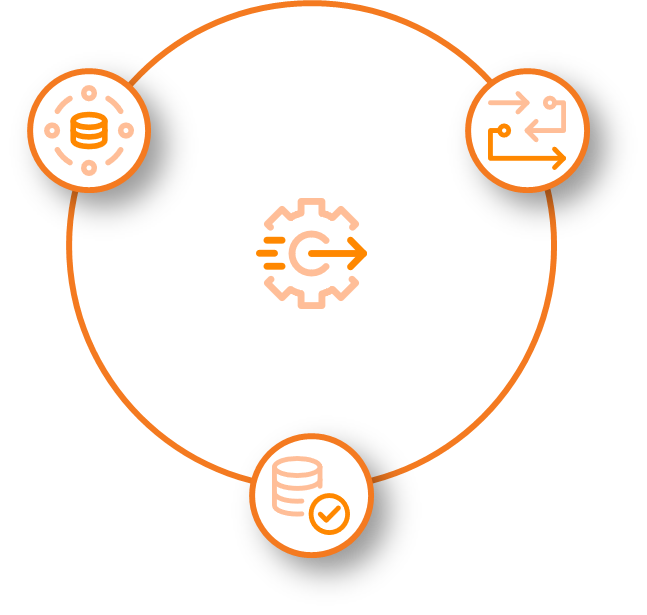
| Product | What it does |
|---|---|
| Data Integration | Build data ingestion, preparation and delivery pipelines. |
| Data Enrichment | Input and maintain critical business data that doesn't belong in other systems. |
| Data Quality | Monitor and maintain data accuracy and reliability standards organization-wide. |
| Orchestration | Handle the scheduling, coordination and monitoring of complex data processes. |
A unified data solution
Data Integration operates as an interconnected architecture that coordinates the management, development and orchestration of complex data workflows. These are the components of an end-to-end solution:
| # | Component | Function |
|---|---|---|
| 1 | Portal | Manage users, data sources and instances. |
| 2 | Desktop App | Develop data workflows and models. |
| 3 | Ingest Server | Move data from sources to Ingest storage. |
| 4 | Architecture | Process and store data on your own infrastructure. |
| 5 | Orchestration | Coordinate, schedule and monitor all data processes. |
Metadata and data flow separately: business logic lives in metadata, while your data stays on your own storage.
1 · The Portal
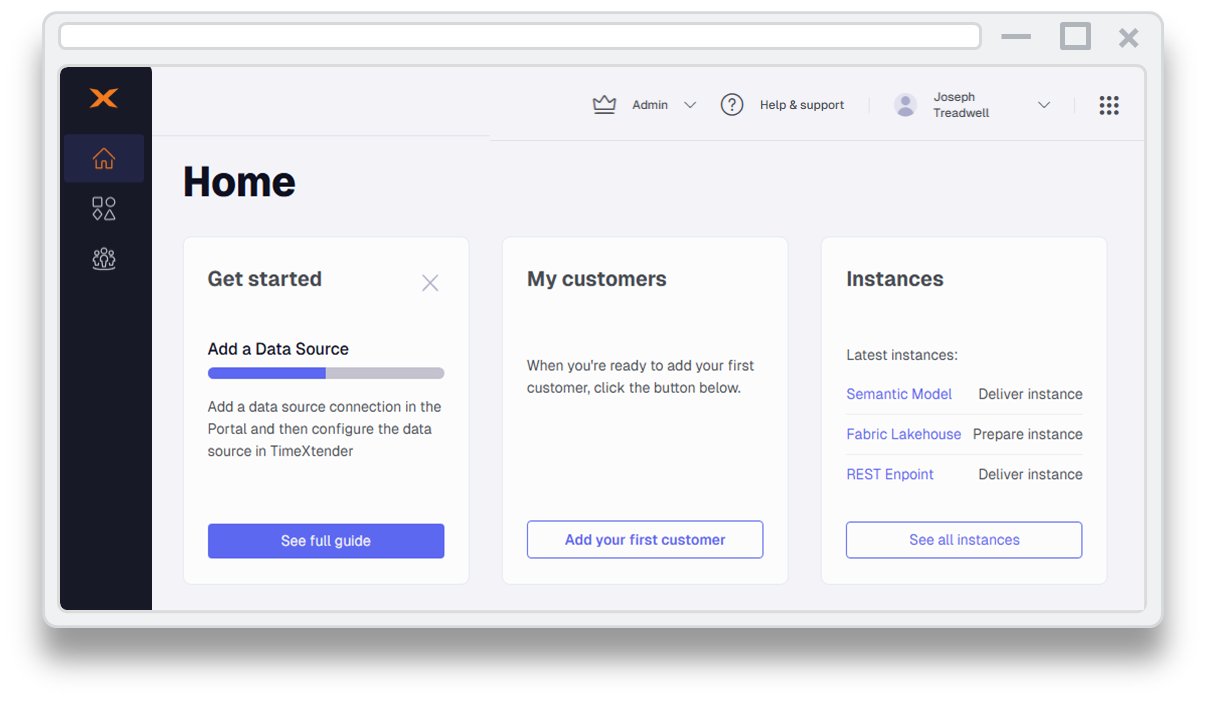
The Portal is where you perform the initial setup of your Data Integration solution. Create your account, invite team members, manage instances and configure data sources. Its guide helps you track the initial setup of an end-to-end solution, linking to the relevant technical documentation along the way.
| Capability | What you do there |
|---|---|
| Tool navigation | Access and navigate between integrated products in the Holistic Data Suite. |
| User management | Give additional team members access to instances and other products. |
| Instance configuration | Create and manage instances, and define their data storage connections. |
| Data connections | Browse, configure and test connections from hundreds of pre-built data source providers. |
| Environment migration | Configure environments and migrate changes across dev, test and production. |
In these docs: Add and configure data sources, Configure user accounts and permissions, Migrate instances across environments.
Instances
Instances are the core building blocks of every Data Integration solution.
When creating an instance you define a target storage — the resource used to process and store your data, such as a database or Lakehouse. Data workflows and business rules are then developed in the Desktop App and deployed to that target storage for execution.
While alternative setups are supported, data typically flows Ingest → Prepare → Deliver.
| Instance | Purpose |
|---|---|
| Ingest | Extract data from disparate sources into a single centralized data lake or Lakehouse. |
| Prepare | Define custom rules and workflows to cleanse, transform and model raw data into a "single version of truth" in a database or data warehouse. |
| Deliver | Design business-friendly semantic models and measures, and publish them to Power BI, Qlik or Tableau. |
This layered architecture lets you build comprehensive data solutions while keeping a clear separation of concerns.
In these docs: Add Ingest instances · Add Prepare instances · Add Deliver instances
A unified metadata framework
Each instance is both a functional workspace and a metadata repository, storing information about data assets, transformations and business rules. That enables intelligent execution, code generation and automated documentation without accessing your data values, so data privacy is preserved. Because the framework is metadata-driven, business logic defined in one instance can inform processes in connected instances.
- Metadata repositories maintain every version of each data object, transformation and dependency within a given instance.
- The metamodel is the overarching integration framework, defining relations, mappings and dependencies between instances.
2 · The Desktop App
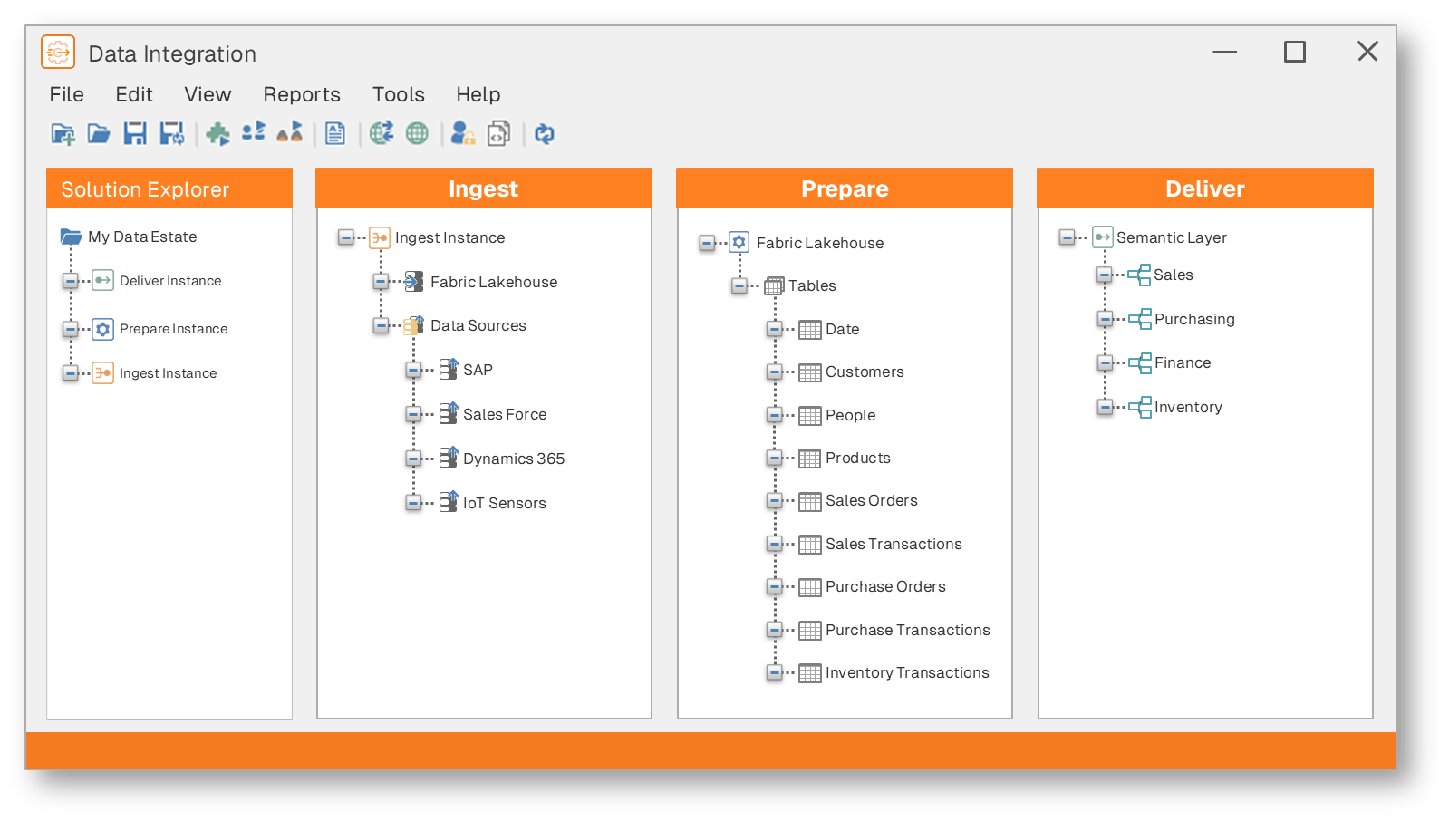
The Desktop application is where data professionals design workflows, transformations and data models locally, using metadata. On deployment, optimized code is generated and executed on the target storage platform. Separating business logic from the runtime gives you performance and data privacy, and a solution that can be redeployed to another data platform later.
Low-code transformation
Data models and complex transformations are defined by drag-and-drop, then converted into optimized code for your target storage.
Intelligent execution
The execution engine uses metadata to manage data processes, giving dependency management, improved performance and cost optimization.
Future-proof agility
Because the approach is metadata-first, once your business logic is defined the code can be regenerated for any supported data platform.
Semantic model creation
Build business-friendly models and data products that give consistent terminology and metrics for analytics consumption.
Lineage and documentation
Use end-to-end data lineage to trace any data point, and generate documentation so users know their data is complete, accurate and reliable.
In these docs: Lineage and Visualization.
Next in the course
SQL Sandbox · Install & Configure · Portal · Ingest Instance
Discussed in the community
Looking for related questions…
Didn't find your answer? Ask the community about this page — questions are answered by Timextender experts, partners and other users.